


Quick answer
Start by writing down the operating problems you want gone. Then ask owners you trust for referrals, and look for people who have run a business and will build inside your tools, not just hand you a plan. Before you hire, get a written scope, a fixed price, and a defined outcome.
Step 1: Define the job first
Write down the work you want off your plate. Not “operations,” the actual work.
A fractional COO is a part-time, contract operations executive. They do the job of a chief operating officer for part of the week, or for a defined piece of the business: processes, systems, vendors, fulfillment, reporting, and the handoffs between people. You get senior operating help without carrying an executive salary before the business is ready for one. Unlike an advisor, a good one builds the system, runs it, and hands it to your team.
What still runs through you today?
Which decisions or processes need an owner?
What keeps breaking, and when?
How many hours a week does it take from you?
That list tells you what kind of fractional COO you need, and gives every candidate the same thing to respond to, so you can compare answers. Most owners bring one in when everything still runs through them, the same problems keep coming back, and they know what needs building but don’t have the time to build it.
Step 2: Know where to look
Referrals from other owners first. Every other source works too, if you vet it the same way.
Wherever you look, check whether they will work inside your tools and your team, or only hand you a plan. Execution is the difference.
Step 3: Ask the right questions
What they built that still runs without them, and what done looks like here.
What did you build at your last client that still runs without you?
Have you run a business yourself, or only advised one?
What would you build here first, and when would it be done?
Will you give me a written scope and a fixed price before work starts?
What does “done” look like, and how will we both know?
Will you work inside our tools and with our team?
What do you need from me each week,
and how will you tell me what moved and what’s blocked?
How do you hand off?
Who owns each system after, and where do the documentation and accounts live when you leave?
The weekly meeting kit
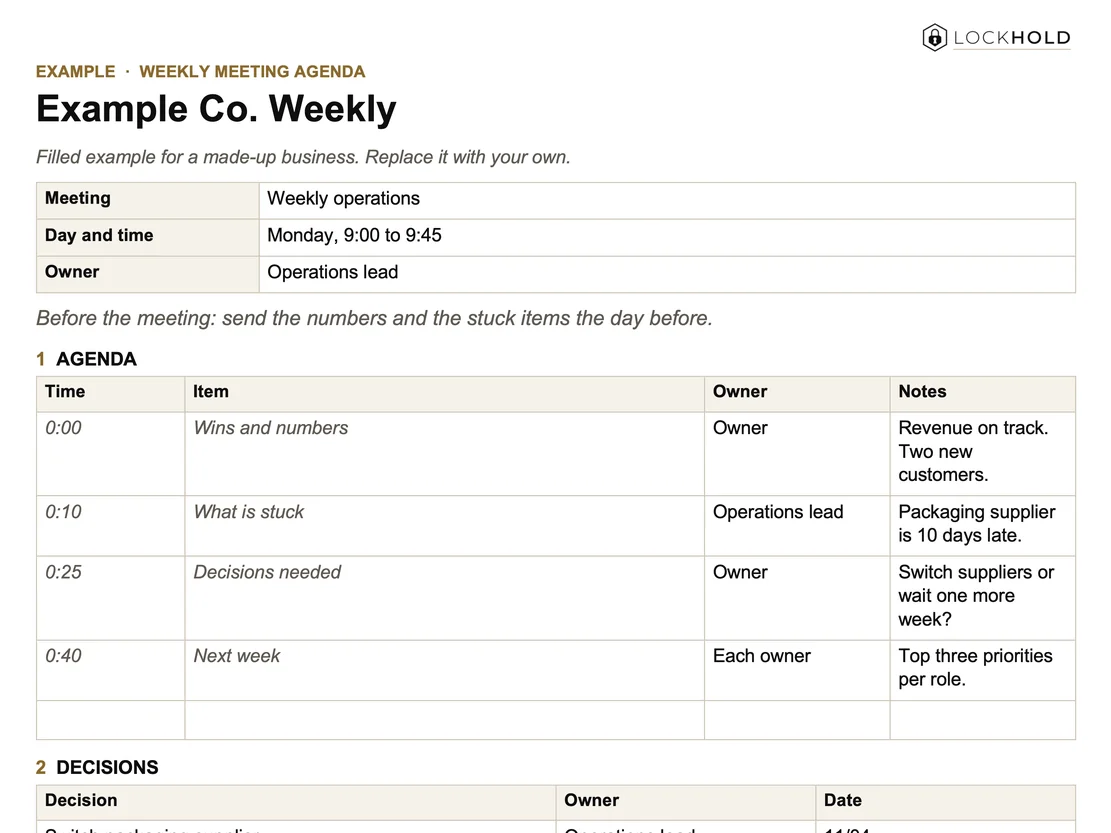
The weekly rhythm that keeps a business running without you in every decision. Works in Word and Google Docs.
- A weekly meeting agenda: numbers, what’s stuck, decisions, next week. Every decision gets an owner and a date.
- An org chart by role, with what each role owns and who backs it up.
- A who-owns-what chart (RACI), plus a how-to page and a filled example.
- Plus the one-page guide: How to find a fractional COO, ready to print or share.
Here's your weekly meeting kit.
Plus the one-page guide: download the PDF.
Check your inbox and click Confirm. Then we’ll email you a copy, and you’ll get our monthly operator note.
That didn't go through. Please try again, or email hello@lockhold.com.
Step 4: Know the good signs and the red flags
A good one starts with how the work actually gets done. A bad one starts with a framework.
A good fractional COO names the first thing they’ll build and when it will be done, gives you a fixed price and a written scope before they start, works with your people, and leaves the business running without them. Walk away if you see these:
A plan, then gone.
They hand you a document and leave.
Strategy first.
They talk strategy before they’ve looked at the work.
No price, no timeline.
Or a scope with no defined outcome.
Open-ended hours.
The meter runs; nothing is ever done.
Nothing to show.
They can’t point to real work they built.
You in every meeting.
If they need you there, they haven’t taken anything off your plate.
Step 5: Set up the engagement
A written scope, a fixed price and a defined outcome, before work starts. If they won’t give all three, keep looking.
A written scope.
What they own, and what they don’t.
A fixed price.
Not an open hourly meter.
A defined outcome.
It’s done when that outcome is running, not when the hours run out.
That’s how we set ours up at Lockhold. The length varies: some are long-term engagements, some a narrow scope. What doesn’t vary is those three.
Fractional COO, operations consultant or full-time COO?
Many owners start fractional. When the full-time hire comes, the processes and reporting are already in place.
FAQ
How much does a fractional COO cost?
It depends on the scope, not the title. Engagements are usually priced by the month or by the project. At Lockhold, every engagement has a written scope and a fixed price before work starts. Ask for the scope and the price together. If they won’t give both, keep looking.
How many hours a week does a fractional COO work?
It depends on the scope, not a set number of hours. Some engagements are a few hours a week of steady oversight; others are close to full-time while a system is being built. Most of the work can be done remotely, with time on site when a facility or team needs it.
Is a virtual COO the same as a fractional COO?
Mostly, yes. Virtual, part-time and fractional COO all describe a senior operator who runs operations for part of the week instead of as a full-time employee. “Virtual” usually signals remote work; “fractional” a set share of time or a defined scope. What matters is what they own and how done is defined.
When should I hire a full-time COO instead?
When the business can carry the salary and needs daily operating leadership on an ongoing basis. A fractional period often sets up that hire well, because the systems are already in place. We don’t do the recruiting itself.
Want it built and running?
Write down the one thing that’s stuck: the process that keeps slipping, the system nobody has time to build. That’s the starting point.
Our fractional COO services start there, with a written scope and a fixed price, and end with the system running in your business. If you have one problem to fix rather than a role to fill, operations consulting may fit better. You can also see the work we’ve built.
Related guides and work

What does a COO do?
What a COO owns day to day, how the role differs from the CEO, and when a business needs one.
Read the guide Guide
How to build a KPI dashboard
The numbers to track, sales first, and how to build a dashboard your team checks every week.
Read the guide Service
Fractional COO
The COO work, without the full-time hire: systems, reporting and handoffs built and handed over.
Read →