


Quick answer
A COO, or chief operating officer, runs a company’s day-to-day operations. They own the systems, the processes, and the delivery, so the work gets done without the owner in every decision. The CEO sets the direction; the COO makes sure the business actually runs that way, every day.
What a COO is
The senior executive responsible for how a company runs day to day, usually second-in-command to the CEO.
Where the CEO decides what the business should do, the COO makes sure it gets done, the same way every time, without every decision going back up the chain. The role looks different in every company, because a good COO fills whatever operating gap the business has. The title tells you less than the job description.
Plenty of companies have someone doing the COO job without the title: a head of operations, a general manager, a long-time right hand. And plenty of small businesses have no one doing it at all, which usually means the owner is doing it by default, on top of everything else.
What a COO does day to day
Builds the processes, sets the reporting rhythm, hires the people, and fixes what breaks before it reaches the owner.
Operations.
How the product or service gets delivered, from sale to finished work, on time and to standard.
People and hiring.
Building the team, setting roles and expectations, and making sure managers can manage.
Systems and process.
The documented way work gets done, so it doesn’t live in one person’s memory. Usually SOPs your team actually uses.
KPIs and reporting.
the handful of numbers that show whether the business is running well, reviewed on a fixed weekly rhythm.
Vendors.
Suppliers, contractors, software and partners, chosen, managed and held to what they promised.
Cross-team handoffs.
Between sales, delivery, finance and support, where most work gets dropped.
A typical week: review the numbers, run the operations meeting, clear the decisions that would otherwise stall, and spend the rest on whatever is breaking or about to. What a COO shouldn’t be doing is the work itself, every day. If the COO ships the orders and answers every escalation, the role has become another bottleneck.
COO responsibilities by company stage
Early on, the job is making anything repeatable. Later, it’s getting the business to run without the owner.
Startup
Keeping delivery on track while the founder sells.
- FocusThe first repeatable processes, and delivery that holds up while the founder is out selling.
- Working whenCustomers get the same experience every time, and the founder isn’t fixing every order.
Growing
A growing small business, where most owner-led businesses we work with sit. It has outgrown how it’s run but is still held together by the owner.
- FocusWriting down how the work gets done, setting up the tools, hiring managers, and a weekly reporting rhythm.
- Working whenThe business keeps running when the owner steps away, and problems show up in the numbers before customers see them.
Midsize
An established midsize company: several teams, each with its own leader, pulling in the same direction.
- FocusRunning several teams or locations, improving margins, and leading larger changes.
- Working whenTeams hit their numbers without escalation, and changes roll out without breaking delivery.
COO vs. CEO: what’s the difference?
The CEO owns direction. The COO owns delivery.
In a small business, the owner usually does both jobs. That works until the operations take up so much time that nobody is doing the CEO job.
When both seats are filled, the relationship matters more than the org chart. The best pairs agree on priorities, split the work cleanly, and back each other in front of the team. When they don’t, people learn to go around one of them.
Types of COO, and the skills that matter
In a small business it’s almost always the operator: someone who runs the day-to-day so the owner can lead.
What a good COO brings
Systems thinking.
Fixes the cause, not the symptom.
Execution.
Gets things finished, not just started.
People leadership.
Hires well, sets clear expectations, and holds people to them without drama.
Comfort with numbers.
Knows which ones matter, reads them every week, and acts on them.
Calm under pressure.
Fixes it first, finds out why second.
Knowing what not to do.
Says no to the tenth project so the first nine get done.
The best COOs have run operations themselves. Industry knowledge helps less than people expect: how work moves, how teams run and how numbers get tracked look much the same across product, service and software companies.
When a business needs a COO
When the owner is the bottleneck. Then decide: full-time, fractional, or one problem fixed.
Decisions queue on your desk.
Work waits for you.
Things break when you step away.
A week off means a week of problems when you get back.
Handoffs get missed.
Work falls between people, and nobody notices until a customer does.
Nobody owns the numbers.
You find out about problems late.
If two or more are true, the business needs someone in the COO seat. Waiting rarely makes it cheaper: the longer operations run through the owner, the more of the business lives in one head, and the harder it is to hand over.
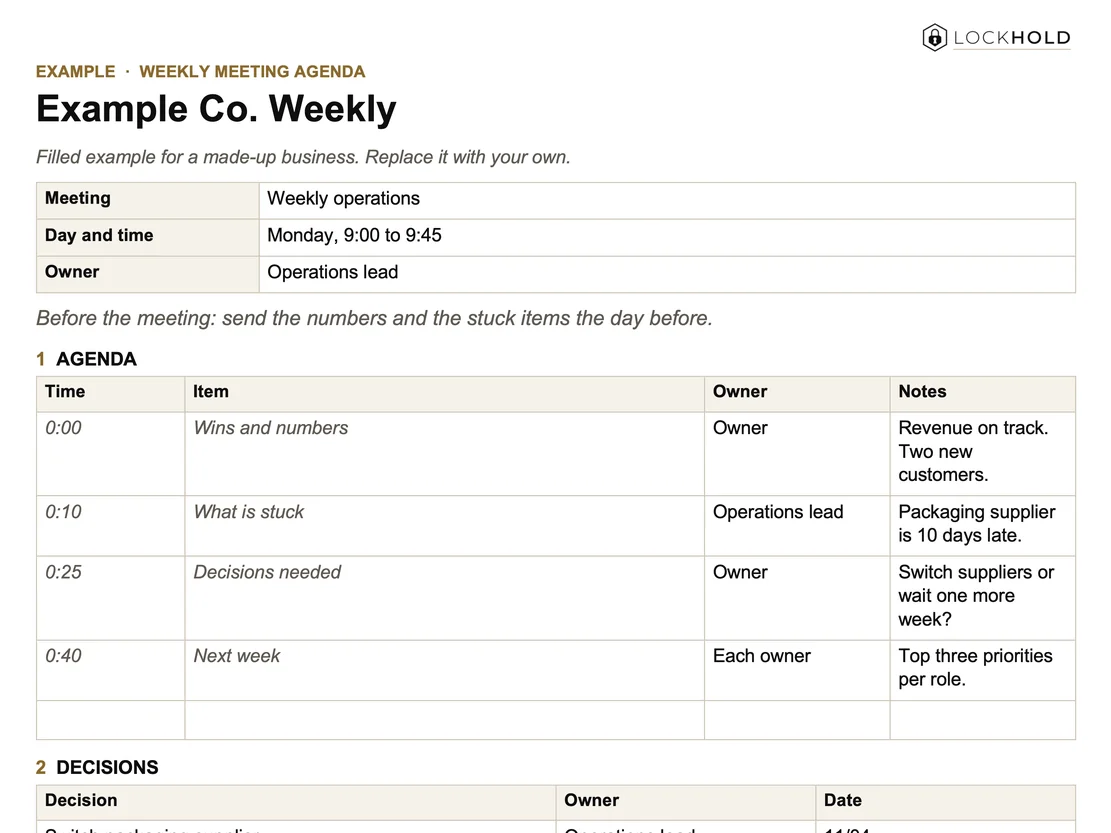
The weekly meeting kit
The weekly rhythm that keeps a business running without you in every decision. Works in Word and Google Docs.
- A weekly meeting agenda: numbers, what’s stuck, decisions, next week. Every decision gets an owner and a date.
- An org chart by role, with what each role owns and who backs it up.
- A who-owns-what chart (RACI), plus a how-to page and a filled example.
- Plus the one-page guide: What does a COO do?, ready to print or share.
Here's your weekly meeting kit.
Plus the one-page guide: download the PDF.
Check your inbox and click Confirm. Then we’ll email you a copy, and you’ll get our monthly operator note.
That didn't go through. Please try again, or email hello@lockhold.com.
FAQ
Is a COO higher than a president?
It depends on the company. In some, the president is the senior operating role and the COO reports to them; in others, one person holds both titles. In most companies, both report to the CEO.
Does a small business need a COO?
Not always as a full-time hire, but it needs the COO work done. Once operations start pulling the owner away from selling, strategy and the work only they can do, someone has to own the day-to-day.
What does a COO do that a GM or operations manager doesn’t?
A COO owns operations across the whole business and sits at the executive level. A general manager usually runs one unit or location, and an operations manager runs the day-to-day of a team or function, often reporting to the COO.
What should a COO not do?
The work itself, every day. A COO who ships the orders, answers every escalation, or makes every small decision has become another bottleneck. The job is building the systems and the team so that work runs without them.
Want it built and running?
If one system or process is stuck, someone can take it off your plate. If it’s the whole operation and the business is large enough, it’s time for the COO seat.
Our fractional COO services take a defined part of the COO work: we build the processes, reporting and handoffs in your business, and hand them over running.
Related guides and work

How to find a fractional COO
What to define first, where to look, what to ask, and the red flags to watch for.
Read the guide Guide
How to build a KPI dashboard
The numbers to track, sales first, and how to build a dashboard your team checks every week.
Read the guide Service
Fractional COO
The COO work, without the full-time hire: systems, reporting and handoffs built and handed over.
Read →