


Quick answer
If the work still needs you to move, the business isn’t running. It’s waiting. Keep direction, pricing, key hires and the final call on risk. Build everything else to run without you: write down the one thing that still runs through you every week, name the role that owns it, train it until it holds, then step out. If it comes back, fix the process, not the person.
The signs it’s time
You have people, but the work doesn’t move without you.
The same problems keep coming back.
You fix them, and next month they’re on your desk again.
You’re the only one who knows how it works.
A process, a customer, a supplier, a system: it lives in your head.
Work slows down when you’re unavailable.
A day of meetings or a week away, and things pile up.
You explain the same thing more than once a week.
Every repeat is a process that isn’t written down.
Decisions queue for you.
People wait for your answer instead of making the call.
You’re the status update.
The team finds out what’s happening by asking you.
If two or more of these are true, the business has grown past the way it’s run. That isn’t a failure. It’s what happens when an owner is good at the work: everything flows toward the person who knows how to fix it. The problem is that the business can now only grow as fast as you can answer questions.
What it costs
Your time goes to the middle of the work, so nobody is doing the owner’s job.
Every hour spent answering a question someone else could answer is an hour not spent on sales, pricing, key customers or what the business does next. Most owners feel this as being busy all day and getting nothing important done.
It also caps the team. Good people want to own something. When every decision comes back to you, they learn to wait, and the ones who want more leave. And it makes the business hard to step away from, hard to grow, and hard to sell: a buyer pays less for a business that only runs with its owner in the room.
What should stay with you
Direction, pricing, key hires and the final call on risk. Everything else can be built to run without you.
The goal isn’t to remove yourself from the business. It’s to remove yourself from the middle of the work, so your time goes to the decisions only the owner can make.
What to hand off first
Start where you repeat yourself most.
The process you explain more than once.
If you keep explaining it, it’s ready to be written down.
The report you pull every week.
The numbers, the order summary, the cash position. Someone else can pull it; you read it.
The intake or follow-up that lives in your inbox.
New leads, customer questions, vendor replies.
The exception only you know how to fix.
Write the rule you use in your head, then hand it off.
The status update the team waits for you to give.
Put it in a weekly meeting or a shared board instead.
Pick one. The one that costs you the most time each week is usually the right place to start.
How to step out of the middle
Write the process. Name the role that owns it. Put the steps where the work happens. Train it until it holds. Then stop doing it.
Most handoffs fail because the process stays in the owner’s head. The fix is to write the process down on one page, name one role that owns the outcome, and put the steps in the tool where the work happens. Train it until you’re sure the owner is equipped. Our guide on how to delegate covers the handoff step by step.
Then step out. Stop checking every result, stop answering the questions the page should answer, and let the owner own it. If it breaks, fix the process, not the person. If you take it back, you teach everyone it was never really handed off.
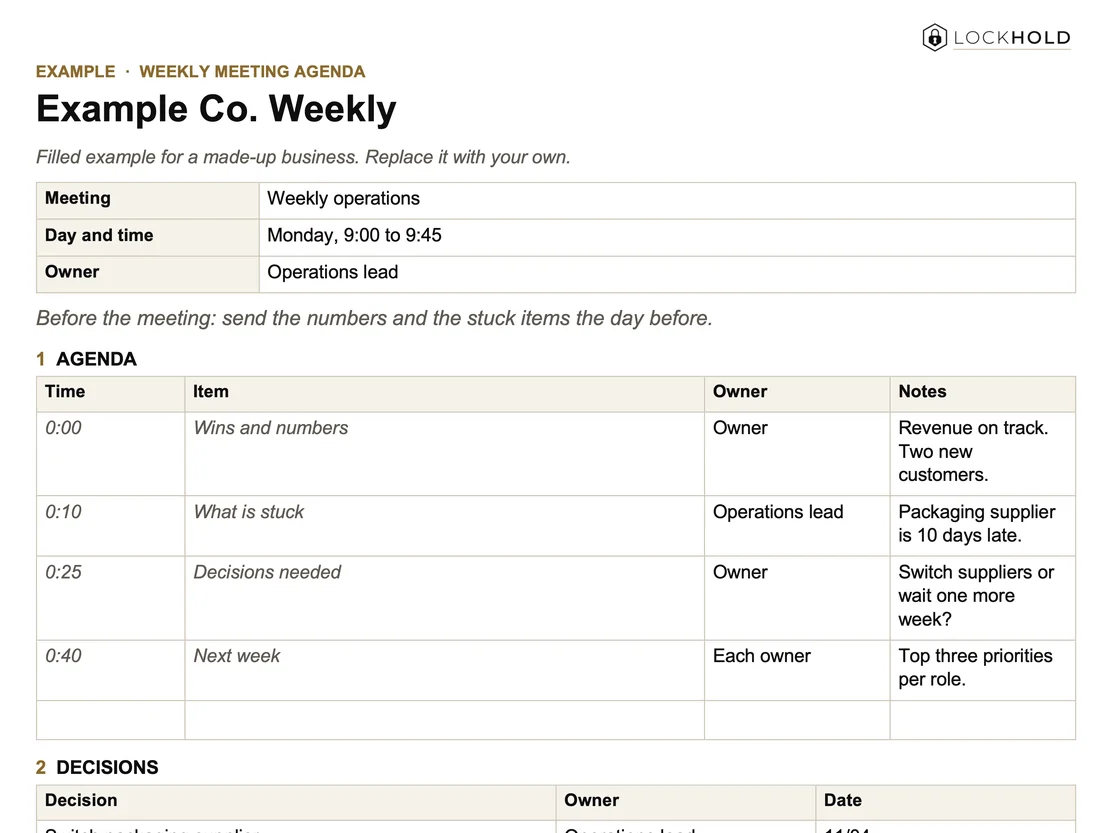
Ownership needs a rhythm to stick: a weekly meeting where each owner reports on their numbers and what’s stuck, and a weekly dashboard so you can see the business without doing the work. the free weekly meeting kit has the agenda, an org chart by role and a who-owns-what chart to start with.
The weekly meeting kit
The weekly rhythm that keeps a business running without you in every decision. Works in Word and Google Docs.
- A weekly meeting agenda: numbers, what’s stuck, decisions, next week. Every decision gets an owner and a date.
- An org chart by role, with what each role owns and who backs it up.
- A who-owns-what chart (RACI), plus a how-to page and a filled example.
Here's your weekly meeting kit.
We also emailed you a copy, and you’ll get our monthly operator note. Unsubscribe any time.
That didn't go through. Please try again, or email hello@lockhold.com.
Your next step
Write down the one thing that still runs through you every week. That’s the starting point.
Build the process. Name the owner. Then step out of it. The first handoff is the hardest. After that, the next ones get easier, because you’ll know what a good handoff needs and the team will have seen it work.
If it still runs through you after you’ve written it down, the process isn’t finished. The owner is still the system.
Everything Still Runs Through Me
When to stop doing it yourself, and what to build first. One page, ready to print or share with your team.
Your guide is ready.
We also emailed you a link to your library, so you can come back to it from any device.
That didn't go through. Please try again, or email hello@lockhold.com.
FAQ
Why does everything in my business run through me?
Usually because you’re the person who knows how everything works. Work flows to whoever can fix it fastest. Until the processes are written down and owned by someone else, it keeps flowing back to you.
What should a business owner stop doing first?
The work you repeat most: the process you explain more than once a week, the report you pull every week, or the follow-up that lives in your inbox. Keep direction, pricing, key hires and the final call on risk.
How long does it take to get out of the day-to-day?
One process at a time. A single handoff usually takes a few weeks from writing it down to fully off your plate. Most owners feel the difference after the first three or four.
Do I need to hire someone to stop being the bottleneck?
Not always. Many bottlenecks clear once the work is written down and owned by people you already have. If there’s more to build than you have time for, a fractional COO can build the systems and hand them over.
Want it built and running?
Pick the one thing that still runs through you every week. Write it down, name the owner, and step out of it.
If there’s more than you have time to build, that’s the work behind Systems & SOPs, and what a fractional COO takes on: the processes, owners and weekly rhythm, built and handed over running.
Related guides and work
How to delegate as a business owner
What to hand off first, a five-step handoff that sticks, and what to do when work comes back.
Read the guide GuideHow to write an SOP your team actually uses
What an SOP is, how to write one step by step, and how to get your team to follow it.
Read the guide ServiceFractional COO
The COO work, without the full-time hire: systems, reporting and handoffs built and handed over.
Read →