


Quick answer
Delegation works when the process is written down and one role owns the outcome. It fails when the work still lives in your head. Pick one task you explain more than once a week, write it on one page, name the owner, put the steps where the work happens, train it until the owner is equipped, and then stop doing it. If it comes back to you, fix the process, not the person.
Why delegation fails
Most owners hand off a task. The process stays in their head, so the work comes back.
You ask someone to take care of it. They do it differently than you would, or they get stuck on the third step and ask you. You fix it, and it’s quicker to do it yourself next time. After a few rounds, the lesson seems to be that nobody else can do it.
That lesson is usually wrong. The person wasn’t the problem; the handoff was. You handed over a task without the information that makes it work: the steps, the exceptions, what good looks like, and who decides when something unusual comes up. Delegation that sticks hands over all of that, in writing.
No written process.
The steps live in your head, so every question comes back to you.
No clear owner.
Two people share it, so neither one really owns it.
No definition of done.
They finish it, but not the way you meant.
You never step out.
You review every result, so the decision still sits with you.
What to delegate first
The work that repeats and the work that stops when you’re not there.
A process you explain more than once a week.
If you keep explaining it, it’s ready to be written down.
A task that stops when you’re unavailable.
Anything that waits for you while you’re traveling or sick.
A report or update the team waits for.
The weekly numbers, the status email, the order summary.
Work that’s written down but still runs through you.
The fastest win: the process exists, you just haven’t let go of it.
Start with one. Pick the item that costs you the most time each week and that someone else could do with clear steps. The first handoff is the hardest. After that, the next ones get easier, because you’ll know what a good handoff needs.
The five-step handoff
Write it, name the owner, put it where the work happens, train it until it holds, and step out.
Write the process on one page.
Steps that start with a verb. The trigger that starts it, the tools it uses, and what done looks like. Write it while you’re doing the work, not from memory.
Name the owner.
One role responsible for the outcome. A role, not a person’s name, so it survives a new hire or a vacation.
Put it where the work happens.
Pinned in the tool they use, linked from the task, printed at the station. Not in a folder nobody opens.
Train it until it holds.
Walk them through it, then watch them run it, as many times as it takes until you’re sure the owner is equipped. Fix the steps that weren’t clear.
Step out.
Stop doing it, stop checking every result, and stop answering questions the page should answer. If it breaks, fix the process.
Step one is where most of the work is. If you’ve never written a process down, our guide on how to write an SOP walks through it, and the free SOP template gives you the one-page format with a filled example.
The one-page SOP template
The format from this guide, ready to fill in. Works in Word and Google Docs.
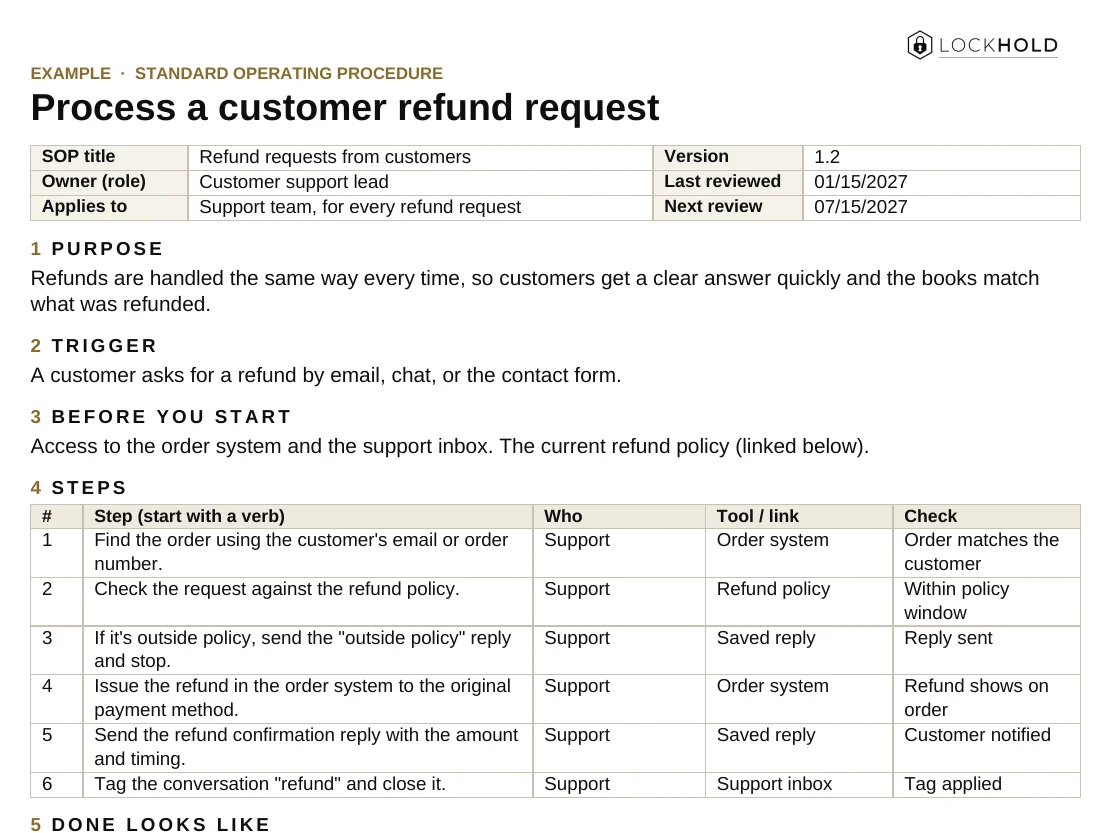
- One page per task: purpose, trigger, steps, who, tools, and what “done” looks like.
- Built-in upkeep: an owner, a review date and a change log.
- A worked example: a customer refund request, filled in.
Here's your SOP template.
We also emailed you a copy, and you’ll get our monthly operator note. Unsubscribe any time.
That didn't go through. Please try again, or email hello@lockhold.com.
What to keep, and what not to delegate
Keep direction, pricing, key hires and the final call on risk. Build everything else to run without you.
The goal isn’t to remove yourself from the business. It’s to remove yourself from the middle of the work, so your time goes to the decisions only you can make.
How you know it worked
The work gets done when you’re not available, and the same problems stop coming back.
It runs without you.
A week away doesn’t pile it up on your desk.
The questions stop.
The page answers them, or the owner does.
The owner can explain it.
They could train the next person without you in the room.
You can see it without doing it.
One number or check on a weekly dashboard tells you it’s on track.
Give it a few weeks. The first runs will be slower than when you did it. That’s normal. What matters is whether it’s getting done without you, and whether it’s getting better each time.
When it comes back to you
If it comes back to you, the process isn’t finished. Fix the process, not the person.
Find the step that broke.
Was a step missing, unclear, or out of date?
Fix the page, not just the result.
Update the process so the same question doesn’t come back.
Check the owner has what they need.
Access, tools, and the authority to make the call.
Hand it back.
Resist taking it over again. Taking it back teaches everyone it was never really handed off.
If the same kind of work keeps coming back across the business, the issue is bigger than one handoff: there’s no system for writing processes down and owning them. That’s the work behind Systems & SOPs, and a big part of what a fractional COO builds.
How to Delegate as a Business Owner
Hand off the work without it coming back to you. One page, ready to print or share with your team.
Your guide is ready.
We also emailed you a link to your library, so you can come back to it from any device.
That didn't go through. Please try again, or email hello@lockhold.com.
FAQ
What should a business owner never delegate?
Setting the direction, pricing, key hires and the final call on serious risk. Almost everything else can be built to run without the owner, once it’s written down and owned.
How do I delegate when nobody does it as well as I do?
Write down what “well” means. Most of the gap is information the other person never had: the steps, the exceptions and what good looks like. Accept that the first few runs will be slower, and fix the process each time something is missed.
How long does it take to delegate a task?
Writing a one-page process usually takes an hour or two, ideally while you do the work. Expect a few weeks of runs before it’s fully off your plate.
What’s the difference between delegating and assigning?
Assigning hands someone a task once. Delegating hands over the process and the outcome, so it keeps getting done without you, the same way every time.
Want it built and running?
Pick one process that still runs through you this week. Write it, name the owner, put it where the work happens, and stop doing it.
If there’s more to hand off than you have time to write down, we document the processes, set the owners and hand them over running. See Systems & SOPs or our fractional COO work.
Related guides and work
How to write an SOP your team actually uses
What an SOP is, how to write one step by step, real examples, and how to get your team to follow it.
Read the guide GuideWhat does a COO do?
What the role owns day to day, and when a growing business needs one.
Read the guide ServiceSystems & SOPs
We document your processes, simplify them, and hand them to your team in a form they’ll use.
Read →