


Quick answer
Bootstrapping means building a business with your own money and the revenue it brings in. No investors: the business pays for its own growth, and you keep control. It takes a product people will pay for now, enough cash to reach the first customers, and the discipline to reinvest instead of taking money out. Build systems and clean numbers as you grow, and a bootstrapped business can be sold.
What bootstrapping means
Building the business with your own money and the revenue it brings in. No investors.
You start with what you have. You sell. You reinvest the profit. You don’t take outside money, so you don’t give up a share of the company or answer to anyone about how you run it. The business grows as fast as its own cash flow allows.
That’s slower than spending an investor’s money, and it’s harder in the early months. But every decision stays yours, the business learns to make money from the start, and when you sell, the proceeds aren’t split with investors.
Lockhold’s founder did it this way: no investors and no money, built sale by sale on cash flow, everything reinvested, and sold four years later in a seven-figure deal.
What it takes
Something people will pay for now, enough cash to reach them, and the discipline to reinvest.
A product or service people will pay for now.
Not after a year of building. Sell early, even if it’s small, so the business funds itself.
Enough cash to reach the first customers.
Your savings or revenue from the first sales. Keep the starting costs as low as you can.
The discipline to reinvest.
Profit goes back into stock, people and sales before it goes into your pocket.
Systems so the work doesn’t all run through you.
Early on you do everything. The business can’t grow past you until what still runs through you is written down and handed off.
Clean numbers.
So you know what’s making money, what isn’t, and what the business is worth.
Growing on your own cash flow
Cash is the limit on everything. Watch it every week, and make money come in before it goes out.
Get paid sooner.
Deposits up front, payment on delivery, short terms. Every day a customer holds your money is a day you’re financing them.
Pay on terms.
Ask suppliers for time to pay, and use it. Pay on the due date, not before.
Keep fixed costs low.
Rent, salaries and contracts don’t drop when sales do. Add them only when revenue can carry them.
Buy what you can sell.
Stock that sits on a shelf is cash you can’t use. Order closer to demand.
Grow at the speed cash allows.
A big order you can’t fund can hurt more than it helps. Ask for a deposit, or take it in stages.
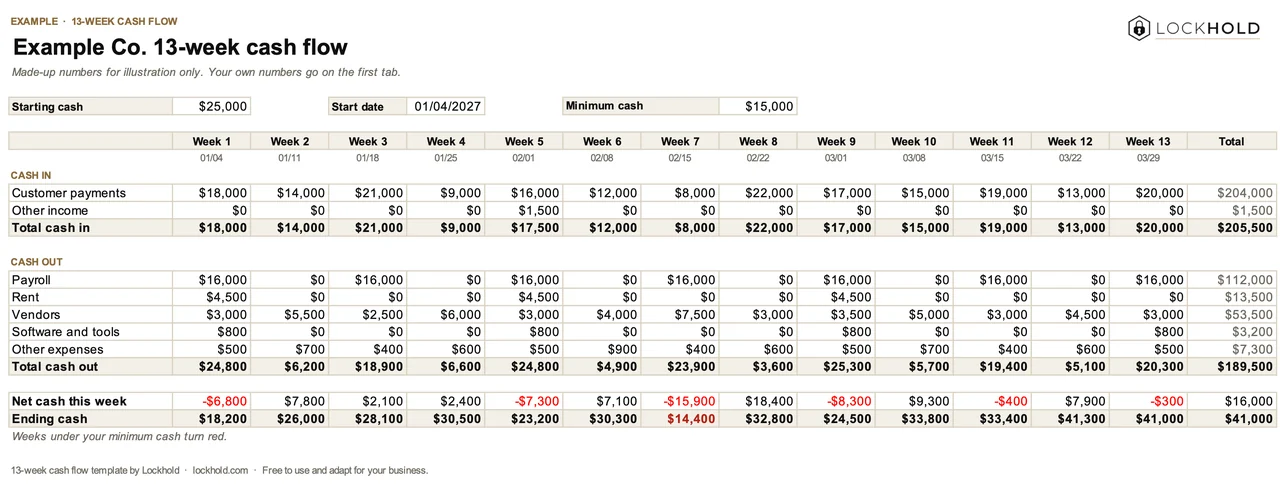
The tool that keeps all of this honest is a 13-week cash flow forecast: a week-by-week view of what’s coming in and going out over the next quarter. It shows a cash gap weeks before it arrives, while there’s still time to chase a payment or delay a purchase. the free 13-week cash flow template gives you the layout and a filled example.
If you use credit this way, treat the payoff date as a hard deadline. Put every balance and its intro end date in the cash forecast, and only borrow what sales already on the way can pay back in time.
The 13-week cash flow template
The forecast from this guide, ready to fill in. Works in Excel and Google Sheets.
- Thirteen weeks on one page: cash in, cash out, net and ending cash for each week.
- A built-in warning: any week below your minimum cash turns red.
- A how-to tab and a filled example so you can see how it reads.
Here's your 13-week cash flow template.
We also emailed you a copy, and you’ll get our monthly operator note. Unsubscribe any time.
That didn't go through. Please try again, or email hello@lockhold.com.
Build the systems early
The habits that make a business sellable are cheaper to build at the start.
In a bootstrapped business the founder does everything at first: selling, making, shipping, billing. That’s normal. The trap is staying there. Write down each process as it settles, at one page each, name who owns it, and hand it off as soon as revenue can pay for the help.
Do the same with the numbers. A monthly close on a fixed day, a handful of numbers the team checks every week, and books your accountant can explain. None of this needs expensive software. It needs a habit, started early.
The exit
A bootstrapped business can be sold. The exit isn’t the goal on day one. It’s the result of building something that works.
Buyers pay for cash flow, and for a business that runs without the owner. A bootstrapped company often has an advantage here: it’s been profitable out of necessity, it carries little or no debt, and there are no investors with their own timeline. The cleaner the operations and the numbers, the easier the conversation.
When a sale is on the horizon, our guide on how to sell your business covers what buyers look at first and a 12-month plan to get ready.
The order matters
First customer, then systems, then clean numbers and an exit.
If you’re starting, get to the first customer. If you’re running, get the work out of your head and into systems. If you’re thinking about an exit, get the numbers and the operations clean.
How to Bootstrap a Business to an Exit
Grow on your own money and revenue, and build something you can sell. One page, ready to print or share with your team.
Your guide is ready.
We also emailed you a link to your library, so you can come back to it from any device.
That didn't go through. Please try again, or email hello@lockhold.com.
FAQ
What does it mean to bootstrap a business?
Building it with your own money and the revenue it brings in, without investors. The business pays for its own growth, and you keep full ownership and control.
Can a bootstrapped business be sold?
Yes. Buyers pay for cash flow and a business that runs without the owner. A bootstrapped business that’s profitable, low on debt and well documented can be an attractive purchase.
How do you grow a business without investors?
Sell early, reinvest the profit, get paid as soon as you can, pay suppliers on terms, keep fixed costs low, and grow at the speed your cash allows. Watch cash every week.
Is bootstrapping better than raising money?
It depends on the business. Bootstrapping keeps control and ownership but grows at the speed of your cash. Raising money can grow faster but means sharing ownership and answering to investors.
Want it built and running?
If you’re starting, get to the first paying customer. If you’re running, start a weekly cash forecast and write down the first process that still runs through you.
If you want someone who has done it alongside you, that’s our startup consulting work: the launch plan, the first systems and the cash discipline. When a sale is closer, see exit planning.
Related guides and work
How to build a 13-week cash flow forecast
A week-by-week view of cash in and out, and the weekly habit that keeps it useful.
Read the guide GuideHow to sell your business: the operations side
What buyers look at first, the prep, a 12-month plan, and why you want more than one buyer.
Read the guide ServiceStartup consulting
Launch plans, go-to-market, and the first systems, from an operator who started at $0.
Read →