


Quick answer
Both take the day-to-day off the owner. The difference is the seat. An integrator is usually a full-time role inside the company that runs the business every day. A fractional COO is a part-time operator who builds the systems, processes and handoffs for a set scope and leaves them running. If you can support a full-time seat and the systems exist, hire an integrator. If the work is stuck and the systems aren’t built yet, start fractional.
The two roles in plain terms
Same goal: the owner stops being the bottleneck. Different seat.
“Integrator” comes from the Entrepreneurial Operating System (EOS), which splits leadership into two seats: one for the founder, who sets direction, and one for the integrator, who runs the business day to day and holds the leadership team to the plan. In practice it’s a full-time, senior operating role, much like a COO or general manager.
A fractional COO does the job of a chief operating officer for part of the week or for a defined piece of the business. If you want the full picture of the role, see what a COO does. The difference that matters here is what each one is for: an integrator runs the machine, a fractional COO builds it.
Integrator vs fractional COO, side by side
One runs the business every day. The other builds how it runs, then hands it over.
When an integrator fits
When the seat is needed every day, and the business can carry it.
There’s a leadership team to run.
Several leads or departments who need one person holding them to the plan.
The systems mostly exist.
Processes are written down and the numbers are tracked; someone needs to run it all, every day.
The business can support the salary.
A senior full-time hire is a real fixed cost.
The owner wants to step back for good.
Not for a project, but as the long-term setup.
Hiring an integrator into a business with no written processes and no reliable numbers is where it usually goes wrong. The new hire spends the first year building what should already exist, often while also running the day-to-day, and the owner wonders why it’s taking so long.
When a fractional COO fits
When the work is more than you can do, but not yet a full-time role.
Everything still runs through you.
Decisions queue on your desk and work stops when you step away.
The systems aren’t built.
The process lives in people’s heads, and nobody owns the weekly numbers.
A full-time seat is too early.
The business can’t yet carry a senior salary, or doesn’t need someone in the seat every day.
There’s a defined job to do.
A rebuild, a new location, getting ready to sell: work with a start and a finish.
A good fractional engagement has a written scope, a set price and a clear definition of done, so you know what will be built and when. That’s how a scoped engagement works.
Fractional first, then hire
Many owners use a fractional COO to build the systems, then hire a full-time operator to run them.
Build the systems.
A fractional COO documents the processes, sets the owners and sets up the weekly rhythm and numbers.
Prove the role.
You see what the seat actually needs to do, so the full-time job description is real, not a guess.
Hire into something that runs.
The integrator or COO starts by running a working system, not building one from scratch.
Hand over.
The fractional COO trains the hire and steps out.
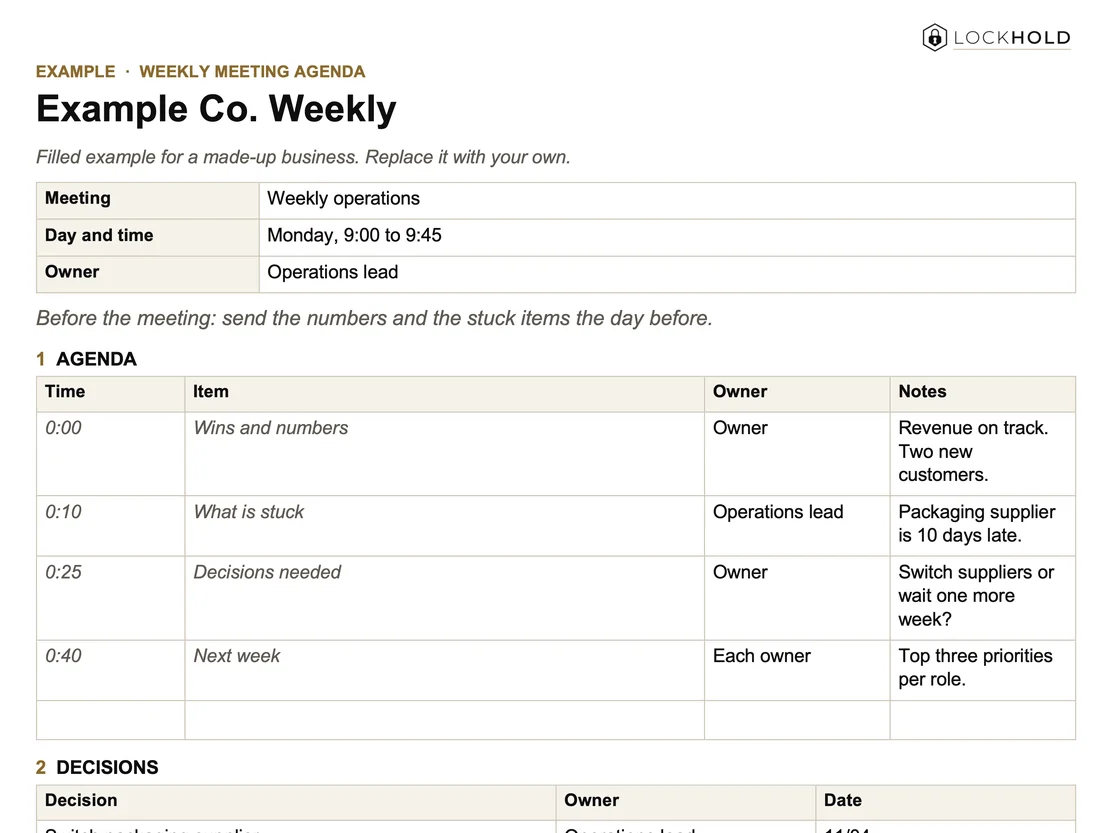
The weekly rhythm is often the first thing to build, whichever way you go. the free weekly meeting kit has the agenda, the org chart by role and the who-owns-what chart to start with.
The weekly meeting kit
The weekly rhythm that keeps a business running without you in every decision. Works in Word and Google Docs.
- A weekly meeting agenda: numbers, what’s stuck, decisions, next week. Every decision gets an owner and a date.
- An org chart by role, with what each role owns and who backs it up.
- A who-owns-what chart (RACI), plus a how-to page and a filled example.
Here's your weekly meeting kit.
We also emailed you a copy, and you’ll get our monthly operator note. Unsubscribe any time.
That didn't go through. Please try again, or email hello@lockhold.com.
The question to ask both
Ask them to name the first process they’d rebuild and how long it would take. The one who can answer has done the work.
Good answer:
a specific process, the first deliverable and a date. “Order intake to delivery. A written process and a weekly report in four weeks.”
Weak answer:
a discovery phase with no end date, a framework, or a plan they hand you and leave behind.
Whichever role you choose, look for someone who has run a business, works inside your tools and team, and leaves things running without them. For the full vetting checklist, see how to find a fractional COO.
Integrator vs Fractional COO
Same goal, different seat: which one your business needs. One page, ready to print or share with your team.
Your guide is ready.
We also emailed you a link to your library, so you can come back to it from any device.
That didn't go through. Please try again, or email hello@lockhold.com.
FAQ
Is an integrator the same as a COO?
Close. Both run the business day to day so the owner can lead. “Integrator” is the term the Entrepreneurial Operating System uses for that seat; many integrators carry the title COO, president or general manager.
Can a fractional COO be our integrator?
For a while, yes. A fractional COO can fill the seat part-time while the systems get built. Once the business needs someone in the seat every day, that’s usually a full-time hire.
Do I need to run EOS to hire an integrator?
No. The term comes from EOS, but the role is common in businesses that don’t use any formal system: a senior operator who runs the day-to-day so the owner can focus on direction.
Which costs more?
A full-time integrator is a senior salary plus benefits, every year. A fractional COO is a set fee for a defined scope. Fractional costs less up front; the right choice depends on whether you need someone in the seat every day.
Want it built and running?
Write down what’s stuck. Decide whether you need someone in the seat every day, or someone to build the systems first. Then choose the role that matches.
If it’s the building that’s needed, that’s what our fractional COO services do: we build the processes, reporting and handoffs in your business and hand them over running, often to the full-time person who comes next.
Related guides and work
How to find a fractional COO
What to define first, where to look, what to ask, and the red flags to watch for.
Read the guide GuideWhat does a COO do?
What the role owns day to day, and when a growing business needs one.
Read the guide ServiceFractional COO
The COO work, without the full-time hire: systems, reporting and handoffs built and handed over.
Read →