


Quick answer
A weekly operating rhythm is a fixed meeting and a fixed set of numbers the team looks at every week. It’s how the business stays on track without the owner in every decision. Same day, same time, same agenda: the numbers, what’s stuck, the decisions needed, and an owner and a date for each. If the meeting doesn’t end with decisions and owners, it isn’t an operating rhythm. It’s a status update.
What a weekly operating rhythm is
A fixed meeting and a fixed set of numbers the team looks at every week.
Without one, the business runs on interruptions. Problems reach the owner whenever someone notices them, decisions get made in hallways and inboxes, and nobody’s sure what was agreed. That’s a big part of why everything still runs through you.
A weekly rhythm gives every problem a place to go and a time to be decided. The team brings the numbers and what’s stuck. The meeting turns them into decisions, each with an owner and a date. Everything else waits for next week.
The agenda
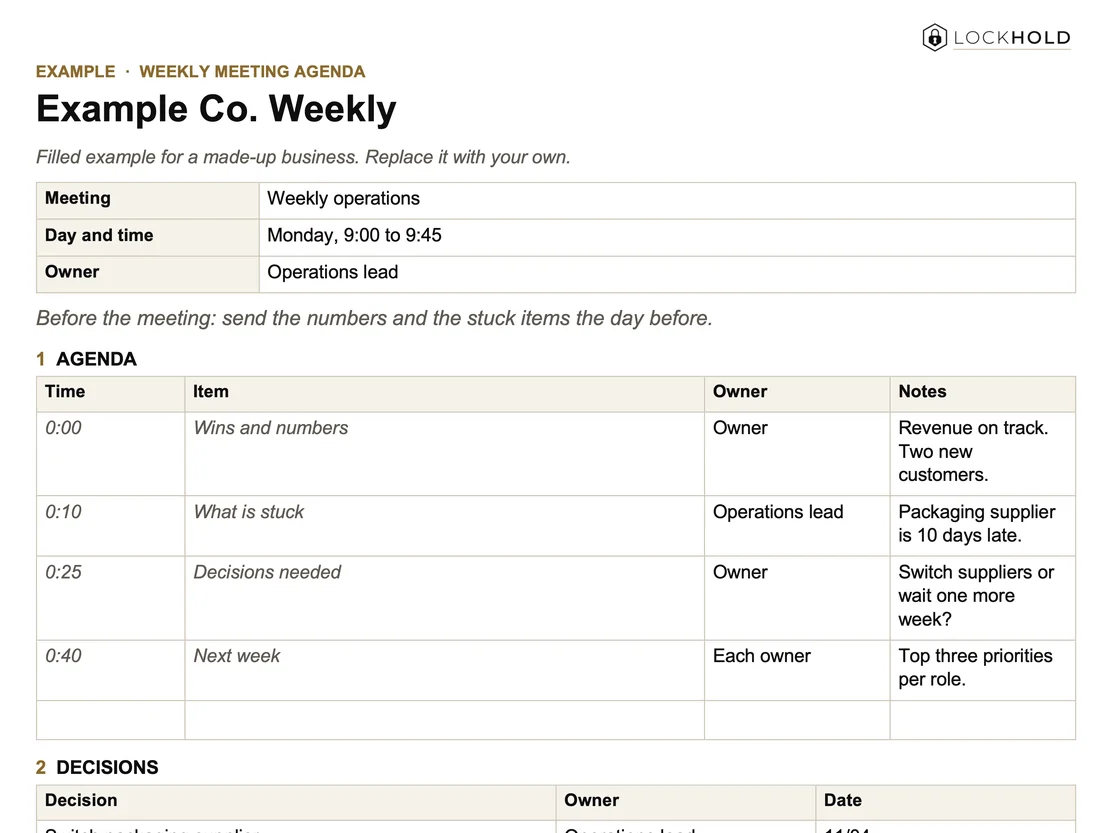
Four parts, in the same order every week.
The numbers.
Eight to ten KPIs, updated before the meeting starts. On track or off track, and who owns each.
What’s stuck.
Anything that isn’t a number but needs a decision: a late supplier, an unhappy customer, a hire.
Decisions needed.
What changes this week. Decide it in the room, or name who decides by when.
Owners and dates.
Read back every decision with its owner and date before the meeting ends.
That’s it. No round of updates, no presentations. If something is on track, it doesn’t need airtime.
The numbers to review
Eight to ten numbers that tell you how the business is running this week, each with one owner.
Sales.
New orders or revenue booked, and the pipeline for the next few weeks.
Delivery.
Orders shipped or jobs finished on time, and the backlog.
Quality.
Errors, returns, rework or complaints.
Cash.
Cash in the bank, what customers owe you, and what’s due out.
People.
Open roles, overtime or capacity, whatever limits your output.
Pick the ones that matter for your business, give each a target, and keep the list the same every week so trends show. A KPI dashboard on one screen makes this five minutes instead of thirty.
How to run it
Same day. Same time. Same agenda. Numbers ready before anyone speaks. End on time.
Fix the slot.
Same day and time every week. Early in the week gives decisions days to happen; the end of the week lets you review the whole week.
Numbers in before the meeting.
Each owner updates their number ahead of time. Nobody looks things up in the room.
Skip what’s on track.
Off-track numbers get an owner and a next step. On-track numbers get nothing.
Write the decisions down.
In one running log the whole team can see, with owner and date.
End on time.
Sixty minutes or less. What doesn’t fit goes to a smaller follow-up with the people involved.
Start next week with last week’s decisions.
Done, or not done and why. This is what makes the rhythm stick.
The weekly meeting kit
The weekly rhythm that keeps a business running without you in every decision. Works in Word and Google Docs.
- A weekly meeting agenda: numbers, what’s stuck, decisions, next week. Every decision gets an owner and a date.
- An org chart by role, with what each role owns and who backs it up.
- A who-owns-what chart (RACI), plus a how-to page and a filled example.
Here's your weekly meeting kit.
We also emailed you a copy, and you’ll get our monthly operator note. Unsubscribe any time.
That didn't go through. Please try again, or email hello@lockhold.com.
A status update vs an operating rhythm
If the meeting doesn’t end with decisions and owners, it’s a status update.
Keeping it going without you
A good rhythm runs whether the owner is in the room or not.
Once the format is set, hand the chair to someone else: an operations lead or a manager. Your job becomes reading the numbers and the decision log, and stepping in only for the decisions only the owner should make. That’s how you delegate without losing sight of the business.
A good sign it’s working: the team knows what’s on track and what isn’t, stuck items have owners, decisions have dates, and you stop chasing the same issues week after week.
Getting started
Pick the day. List the numbers. Write the agenda. Run it once. Then run it the same way every week.
The first few meetings will feel clumsy: numbers missing, decisions vague, the meeting running long. Keep the format anyway and tighten it each week. the free weekly meeting kit has the agenda, a decisions log, an org chart by role and a who-owns-what chart, with a filled example.
The Weekly Operating Rhythm That Actually Runs
A fixed meeting and a fixed set of numbers, every week. One page, ready to print or share with your team.
Your guide is ready.
We also emailed you a link to your library, so you can come back to it from any device.
That didn't go through. Please try again, or email hello@lockhold.com.
FAQ
What is a weekly operating rhythm?
A fixed weekly meeting where the team reviews a fixed set of numbers, raises what’s stuck, and leaves with decisions that each have an owner and a date. It keeps the business on track without the owner in every decision.
What should be on a weekly business meeting agenda?
Four parts: the numbers (eight to ten KPIs), what’s stuck, decisions needed, and an owner and date for each decision. Start each meeting by checking last week’s decisions.
How long should a weekly operations meeting be?
Sixty minutes or less. With the numbers ready beforehand and on-track items skipped, most teams need less. Anything that doesn’t fit goes to a smaller follow-up.
Who should run the weekly meeting?
The owner can at first, to set the format. Then hand it to an operations lead or manager, so the rhythm runs whether the owner is in the room or not.
Want it built and running?
Pick the day and time. List the eight numbers and who owns each. Write the four-part agenda. Run it once this week, then the same way next week.
If you want the rhythm, the numbers and the owners built with you, that’s part of what a fractional COO sets up: the weekly meeting, the dashboard and the who-owns-what, handed over running.
Related guides and work
How to build a KPI dashboard for a small business
The KPIs worth tracking, an example layout, and how to build a dashboard your team checks every week.
Read the guide GuideEverything still runs through me
The signs, what should stay with the owner, and what to hand off first.
Read the guide ServiceFractional COO
The COO work, without the full-time hire: systems, reporting and handoffs built and handed over.
Read →