


Quick answer
A 3PL (third-party logistics company) stores, picks, packs and ships your orders. You send them the product, they run the warehouse and the shipping, and you keep the customer. Consider one when packing is taking your time, you’re out of space, shipping errors are costing customers, or doing it yourself costs more than handing it off. Compare the total cost, not the rate, and weigh what you give up in control.
What a 3PL does
A 3PL stores your product, picks and packs each order, and ships it. You keep the customer.
3PL stands for third-party logistics. You send your inventory to their warehouse. Your store sends them each order, usually through an integration. They pick the items, pack them, ship them, and send the tracking back to your store. Most also handle returns.
You still own the product, the customer, the brand and the store. What you hand off is the warehouse, the packing table and the shipping labels, and the people and space it takes to run them.
When to consider one
When fulfillment is costing you more than it would cost to hand it off: in time, space, errors or growth.
You’re packing orders yourself.
And it’s taking time away from selling and running the business.
You’re running out of space.
And the next step is a bigger lease or a second building.
Shipping errors are costing you customers.
Wrong items, damaged boxes, late orders.
You want to sell in more places.
And you can’t ship fast enough from one location.
Doing it yourself costs more.
Once you add up staff, space, materials and mistakes.
Keep it in-house, or hand it to a 3PL
In-house keeps control. A 3PL can keep overhead lower. Both are good answers for the right business.
To weigh it properly, put both options into a 13-week cash flow forecast. A building is a fixed cost every month. 3PL fees rise and fall with orders. Which one your cash can carry is often the deciding factor.
How 3PLs charge
Most charge for several things. Ask for every fee type before you compare.
The cheapest rate is not always the lowest total cost. Run your last three months of orders through each 3PL’s fees and compare the totals.
What to check before you sign
Volume, integration, receiving, errors, and who you call when it breaks.
Can they handle your volume?
Today, at your busiest week, and where you expect to be in a year.
Do they integrate with your store or system?
Orders, inventory counts and tracking should flow without anyone retyping them.
What is the receiving process?
How fast new stock is available to sell, and what happens when a shipment is short or damaged.
What happens when something is wrong?
Wrong item, damaged order, lost package: who pays, and how fast it’s fixed.
Who do you call when it breaks?
A named person, not a ticket queue, and how fast they answer.
Ask for references from a business your size, and ask them the last question first.
Switching without breaking orders
Write the standard down, move in stages, and test before customers feel it.
Write down your packing standard.
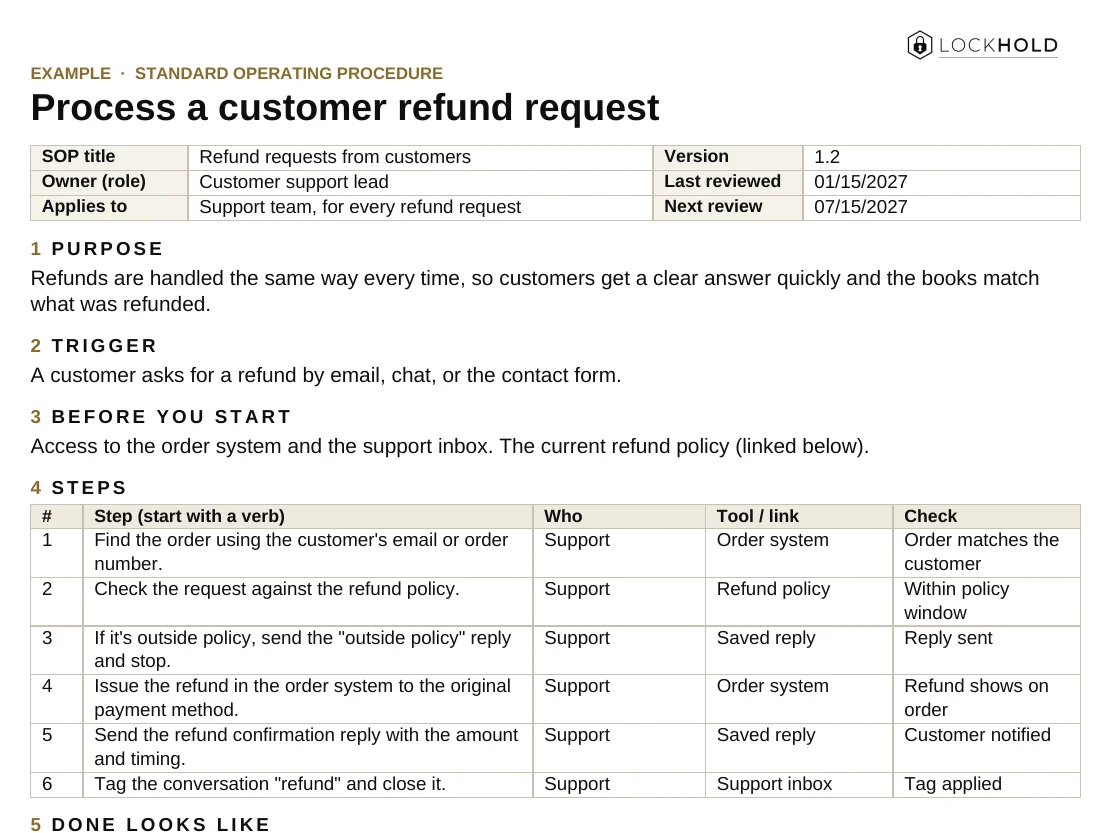
How each order is packed, what goes in the box, and how fast it ships, on a one-page SOP. The 3PL can only match a standard they can read.
Count your inventory.
Know exactly what you’re sending, so you can check what they receive.
Connect and test.
Run test orders through the integration before real orders flow.
Move in stages.
Start with one product line or one channel, and keep shipping the rest yourself until it holds.
Check the first weeks closely.
Order accuracy, shipping time and customer complaints, every week, until the numbers settle.
It’s a handoff like any other: write it down, name the owner, check it, then step out. Our guide on how to delegate covers the steps. the free SOP template gives you the one-page format, and it works just as well if you keep fulfillment in-house.
The one-page SOP template
The format from this guide, ready to fill in. Works in Word and Google Docs.
- One page per task: purpose, trigger, steps, who, tools, and what “done” looks like.
- Built-in upkeep: an owner, a review date and a change log.
- A worked example: a customer refund request, filled in.
Here's your SOP template.
We also emailed you a copy, and you’ll get our monthly operator note. Unsubscribe any time.
That didn't go through. Please try again, or email hello@lockhold.com.
What Is a 3PL, and When Should You Use One?
Hand off storage, packing and shipping, and when it makes sense. One page, ready to print or share with your team.
Your guide is ready.
We also emailed you a link to your library, so you can come back to it from any device.
That didn't go through. Please try again, or email hello@lockhold.com.
FAQ
What does 3PL stand for?
Third-party logistics. A 3PL is a company that stores your inventory, picks and packs your orders, and ships them for you.
When should a small business use a 3PL?
When packing orders takes time away from the rest of the business, you’re running out of space, shipping errors are costing customers, or doing it yourself costs more than handing it off.
How much does a 3PL cost?
It depends on your volume, product size and the fees each 3PL charges: receiving, storage, pick and pack, shipping, and often a monthly minimum. Ask for every fee type and compare the total for a real month of orders, not the rates.
Is it better to keep fulfillment in-house?
It can be. In-house gives you full control over packaging and timing. A 3PL can keep overhead lower and grow with your volume. Compare the total cost and how much control you need.
Want it built and running?
Add up what fulfillment costs you now: time, space, materials and errors. Then ask two 3PLs for every fee type, and compare the total, not the rate.
If you want help setting it up, or setting up the store back end it connects to, that’s our Shopify & 3PL operations work: fulfillment and inventory that hold up when volume rises.
Related guides and work
How to build a 13-week cash flow forecast
A week-by-week view of cash in and out, and the weekly habit that keeps it useful.
Read the guide GuideHow to write an SOP your team actually uses
What an SOP is, how to write one step by step, and how to get your team to follow it.
Read the guide ServiceShopify & 3PL operations
Store back end, fulfillment and inventory set up so orders keep moving as you grow.
Read →