


Quick answer
Hiring more people before the processes are built usually makes the problem bigger: the new people still need you to explain the work. Fix the systems first. Write the processes the new person would own, name the current owners, put the work in the tools the team already uses, and set a weekly rhythm. When a new person could follow the work without asking you every day, then hire.
Why hiring first usually backfires
New people still need you to explain the work. More people means more explaining.
When the business is stretched, hiring feels like the obvious fix. Someone to take calls, run orders, handle the office. But if the work lives in your head, the new person can only do it by asking you. Your week gets busier, not lighter, and the new hire gets frustrated because nobody can tell them what good looks like.
The same goes for problems that keep coming back. If orders go wrong because the process is unclear, a second person running an unclear process makes twice as many mistakes. Hiring adds capacity. It doesn’t add clarity.
Signs you’re about to hire for the wrong reason
If any of these are true, fix the system before you add a person.
The work still runs through you.
Decisions, approvals and answers wait for you. That’s the sign the work still runs through you.
The same problems keep coming back.
You fix them, and next month they’re on your desk again.
You explain the same process more than once a week.
Every repeat is a process that isn’t written down.
There’s no written process for the role.
You couldn’t hand a new person a page that says how the job is done.
The team is waiting on you for decisions.
More people will mean a longer queue.
What to fix first
Write it down, name the owners, put it in the tools, set the rhythm, and define done.
Write the processes the new person would own.
At one page per process: the steps, the tools and what done looks like.
Name the current owners.
Who does each piece today, even if it’s you. You can’t hand off what nobody owns.
Put the work in the tools the team already uses.
Not in your inbox or your head. A shared place the new person can see on day one.
Set the weekly rhythm.
A fixed meeting and a fixed set of numbers, so work moves without you. Our weekly operating rhythm guide covers it.
Decide what done looks like for the role.
Which numbers they own, and what good looks like at 30, 60 and 90 days.
This is often the work that makes the business feel less stretched on its own. Some owners find that once the processes are written and owned, the people they already have can carry more, and the hire can wait.
When the role is ready for a hire
When a new person could follow the work without asking you every day.
The processes are written.
A new person could read how the job is done.
The tools are in place.
The work lives somewhere they can see and use.
The weekly rhythm runs.
There’s a meeting and a set of numbers they’ll report on.
Done is defined.
You both know what good looks like in the first 90 days.
If the new person would still need you to explain the work, the systems aren’t ready yet. That’s not a reason never to hire. It’s the list of what to finish first.
The weekly meeting kit
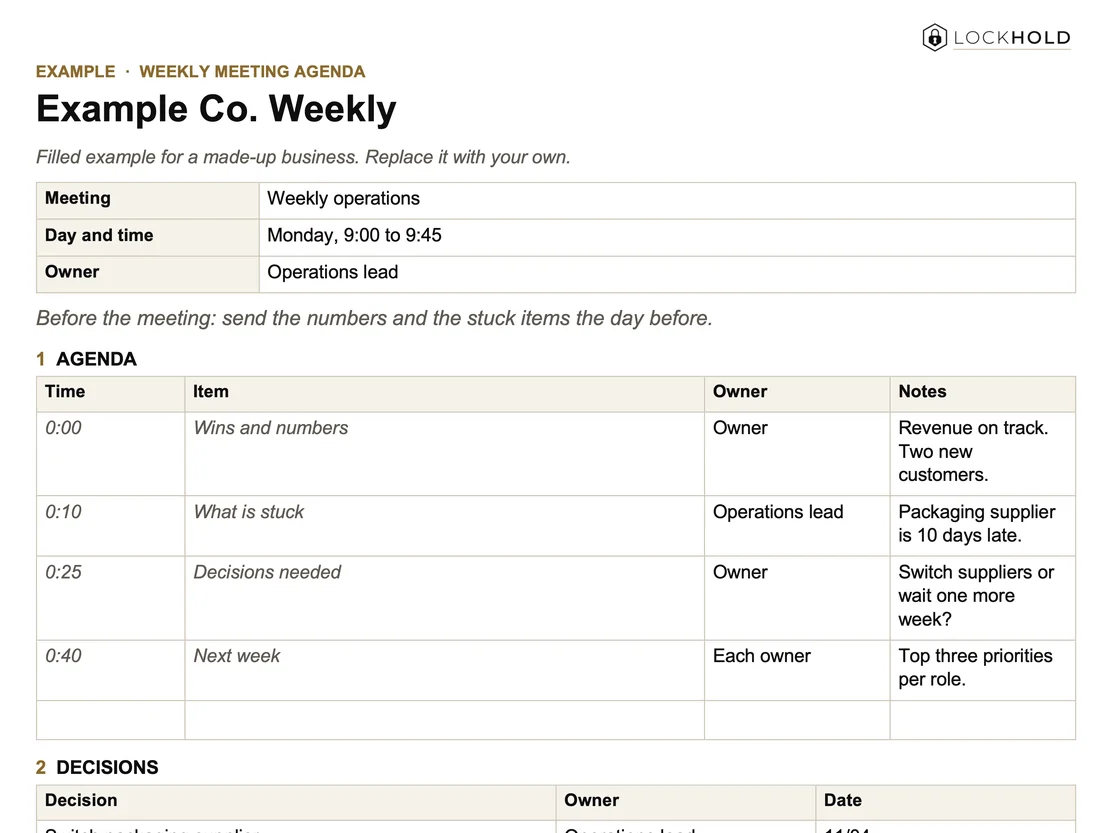
The weekly rhythm that keeps a business running without you in every decision. Works in Word and Google Docs.
- A weekly meeting agenda: numbers, what’s stuck, decisions, next week. Every decision gets an owner and a date.
- An org chart by role, with what each role owns and who backs it up.
- A who-owns-what chart (RACI), plus a how-to page and a filled example.
Here's your weekly meeting kit.
We also emailed you a copy, and you’ll get our monthly operator note. Unsubscribe any time.
That didn't go through. Please try again, or email hello@lockhold.com.
When a hire really is the answer
When the processes work, but there’s more of the work than your people can do.
Setting up the new hire to succeed
Give them the processes on day one, an owner to learn from, and numbers to own.
Day one: the pages.
The written processes for their role, and where the work lives.
Week one: shadow, then do.
Watch the current owner, then do the work while the owner watches.
Weeks two to four: own it.
They run the process; the previous owner checks results, not every step.
From the first month: report the numbers.
In the weekly meeting, like every other owner.
When they find a step that’s wrong or missing, they update the page. That keeps the processes current, and it’s the first sign they’re taking ownership. the free weekly meeting kit has an org chart by role and a who-owns-what chart to set this up.
What to Fix Before You Hire More People
Fix the systems first, or new hires make the problem bigger. One page, ready to print or share with your team.
Your guide is ready.
We also emailed you a link to your library, so you can come back to it from any device.
That didn't go through. Please try again, or email hello@lockhold.com.
FAQ
How do I know if I should hire more employees?
When the processes are written and working, and there’s more of the work than your people can do. If the work is unclear or still runs through you, fix that first, or the new person will inherit the problem.
What should I do before hiring my first employee?
Write down the processes the person would own, decide where the work lives, decide what done looks like at 30, 60 and 90 days, and set a weekly check-in where they report their numbers.
Why do new hires fail in small businesses?
Often because the job was never defined. The processes live in the owner’s head, so the new person can’t succeed without constant help, and both sides get frustrated.
Should I hire or fix my processes first?
Fix the processes first if the same problems keep coming back or you’re explaining the same work every week. Hire when the processes work and the team simply has more work than it can carry.
Want it built and running?
Write down the role you think you need. Then write the processes that role would own. If those aren’t written, that’s the first job, and it might change the hire.
If you want the systems built before you hire, that’s where our operations consulting starts: we find what’s stuck, build the processes and owners, and make the next hire easier to bring on.
Related guides and work
How to hire your first operator
What the role really is, what to look for, hire or partner, and the interview question that matters.
Read the guide GuideThe weekly operating rhythm that actually runs
The agenda, the numbers to review, how to run the meeting, and how to keep it going without you.
Read the guide ServiceOperations consulting
We find where the business is stuck, then build the processes and systems that fix it.
Read →