


Quick answer
Operations management is the work of making sure the processes, the tools and the people keep the business running without the owner in every decision. It covers the processes that turn work into finished outcomes, the tools the team uses, the owner of each process, the weekly numbers, and the handoffs. In a small business it’s usually one person building the systems until the work moves on its own.
What operations management includes
The processes, tools, owners, numbers and handoffs that turn work into finished outcomes.
The processes.
How an order, a job or a service gets from start to finished, as written processes the team follows.
The tools.
The systems the team actually uses, set up so the work lives there and not in someone’s inbox.
The owners.
One person accountable for each process. See who owns what.
The weekly numbers.
A short set of measures, on a KPI dashboard, that show whether it’s working.
The handoffs.
So work doesn’t stop between people, or when someone is out.
In a big company, operations is a department. In a small business it’s usually one person, often the owner at first, building these pieces one at a time until the work moves on its own.
What it isn’t
Not strategy, and not a plan that sits in a document.
Strategy decides where the business goes and what it won’t do. Operations management makes sure the work gets done well every day on the way there. Both matter, but they’re different jobs, and a great strategy with no operations behind it stays a slide.
It also isn’t a binder. If the processes are written but nobody follows them, or the tools are bought but the work still happens in email, the operations aren’t built. If the owner still has to explain how something gets done, they’re not finished.
What a typical week looks like
Review the numbers, clear what’s stuck, improve one process, and keep the handoffs clean.
Monday: the numbers.
Check the weekly measures, and run the weekly operating rhythm meeting: what’s off track, who owns it, and by when.
Through the week: clear what’s stuck.
The late supplier, the order that fell between two people, the customer who’s waiting.
Improve one process.
Each week, fix or write down one process that broke or still depends on one person.
Check the handoffs.
Make sure new people, new products and new tools are folded into the processes and the chart of who owns what.
End of week: what’s next.
What changed, what’s at risk next week, and what the owner needs to decide.
How it looks when it works
The team knows what to do, the numbers are reviewed every week, stuck items have owners, and the business runs without the owner in the room.
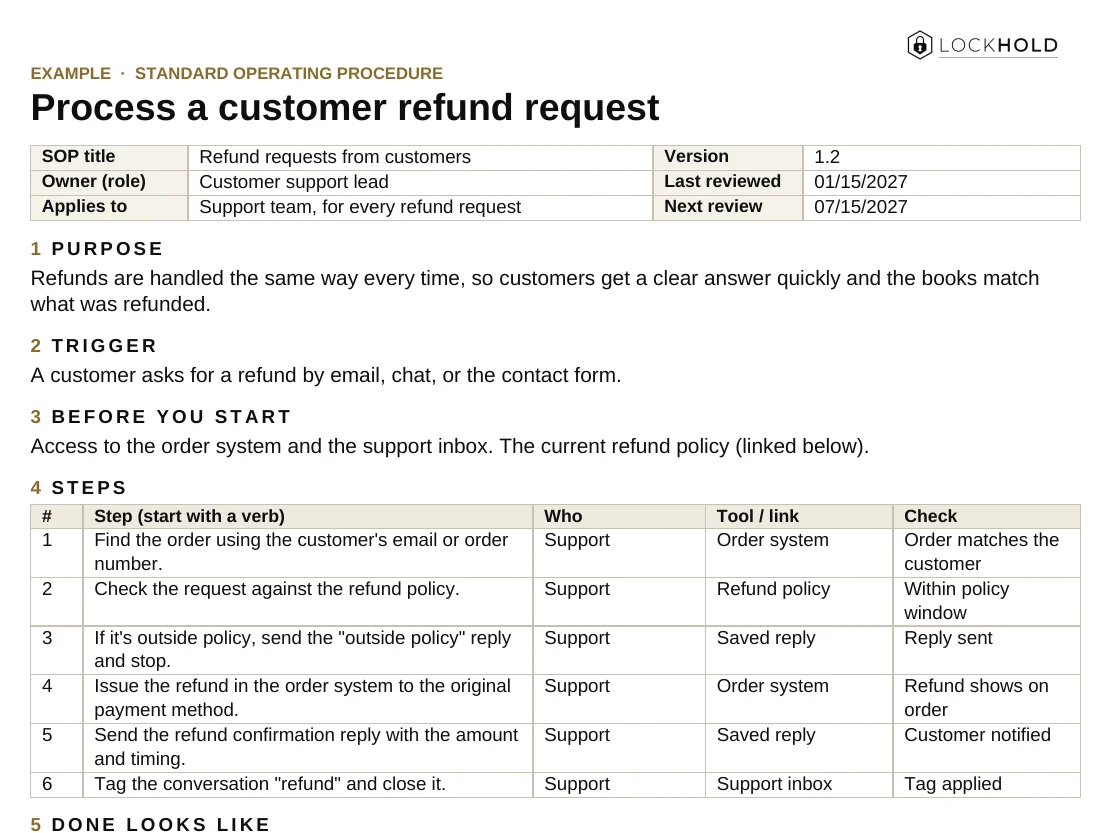
Getting there starts with writing down how the work is done. the free SOP template gives you a one-page format and a filled example.
The one-page SOP template
The format from this guide, ready to fill in. Works in Word and Google Docs.
- One page per task: purpose, trigger, steps, who, tools, and what “done” looks like.
- Built-in upkeep: an owner, a review date and a change log.
- A worked example: a customer refund request, filled in.
Here's your SOP template.
We also emailed you a copy, and you’ll get our monthly operator note. Unsubscribe any time.
That didn't go through. Please try again, or email hello@lockhold.com.
Who should do it
The owner first, then an operator, depending on your size.
Where to start
Write down the processes that still run through you. Name the owners. Put them in the tools the team uses.
That’s the start of operations management. If you want a structured way to find what to build first, run a 30-day systems audit.
What Operations Management Looks Like
The processes, tools and people that keep a small business running. One page, ready to print or share with your team.
Your guide is ready.
We also emailed you a link to your library, so you can come back to it from any device.
That didn't go through. Please try again, or email hello@lockhold.com.
FAQ
What is operations management in a small business?
The work of making sure the processes, tools and people keep the business running without the owner in every decision: written processes, the right tools, an owner for each process, weekly numbers, and clean handoffs.
What does an operations manager do in a small business?
They build and run the day-to-day systems: writing and improving processes, keeping the tools working, making sure each process has an owner, reviewing the weekly numbers, and clearing what’s stuck.
What is the difference between operations and strategy?
Strategy decides where the business is going and what it won’t do. Operations management makes sure the work gets done well every day along the way.
When does a small business need an operations manager?
When the owner has become the bottleneck: decisions wait for them, the same problems keep coming back, and their time is needed on sales and customers instead.
Want it built and running?
Write down the processes that still run through you. Name one owner for each. Put them in the tools the team already uses. Then review the numbers every week.
If you want it built with you, that’s our operations consulting work: we find what’s stuck, then build the processes and systems that fix it.
Related guides and work
The 30-day systems audit
What to check, a week-by-week plan, and how to decide what to build first.
Read the guide GuideWhat does a COO do?
What a chief operating officer owns day to day, and when a growing business needs one.
Read the guide ServiceOperations consulting
We find where the business is stuck, then build the processes and systems that fix it.
Read →