


Quick answer
An org chart shows who reports to whom. A RACI shows who owns each process: who is Responsible for doing the work, who is Accountable for the outcome, who is Consulted and who is Informed. Both are useful, but the RACI is the one that stops work from running through you. Give every process exactly one Accountable person. If more than one person is Accountable, no one is.
Org chart vs RACI
An org chart shows the structure. A RACI shows who owns the work.
Most of the work in a small business crosses roles. An order touches sales, the warehouse and the office. The org chart can’t tell you who owns that order from start to finish, so when it goes wrong, it comes back to the owner. That’s a big part of why the work still runs through you. The RACI answers the question the org chart can’t.
What the four letters mean
Responsible does it. Accountable owns it. Consulted is asked. Informed is told.
R: Responsible.
The people who do the work. There can be several.
A: Accountable.
The one person who owns the outcome and makes the final call. Exactly one per process.
C: Consulted.
People whose input is needed before a decision or a step. Asked first.
I: Informed.
People who need to know what happened. Told after.
The rule that matters most: one Accountable per process. If more than one person is Accountable, no one is. Each assumes the other has it, and the problem lands back on your desk.
How to build one
Start from the work, not the org chart.
List the core processes.
The ten or fifteen things the business does every week or month: quoting, ordering, delivery, invoicing, hiring, payroll. A process map helps if you’re not sure where one ends.
Name one Accountable for each.
A role, not a name, so it survives someone leaving.
Name who is Responsible for the steps.
The roles that actually do the work.
Add Consulted and Informed only where needed.
Too many Cs slows everything down.
Put it where the team can see it.
A shared doc or the wall, not your desktop.
Review it when the work changes.
A new hire, a new product, a process that keeps breaking.
An example for a small business
A simple RACI for a business that makes and ships orders. Yours will look different; the format is the point.
Notice that the owner is Accountable for one row, not five. Everywhere else the owner is Consulted on the rare decision or Informed in the weekly numbers. That’s what getting out of the middle looks like on paper.
The weekly meeting kit
The weekly rhythm that keeps a business running without you in every decision. Works in Word and Google Docs.
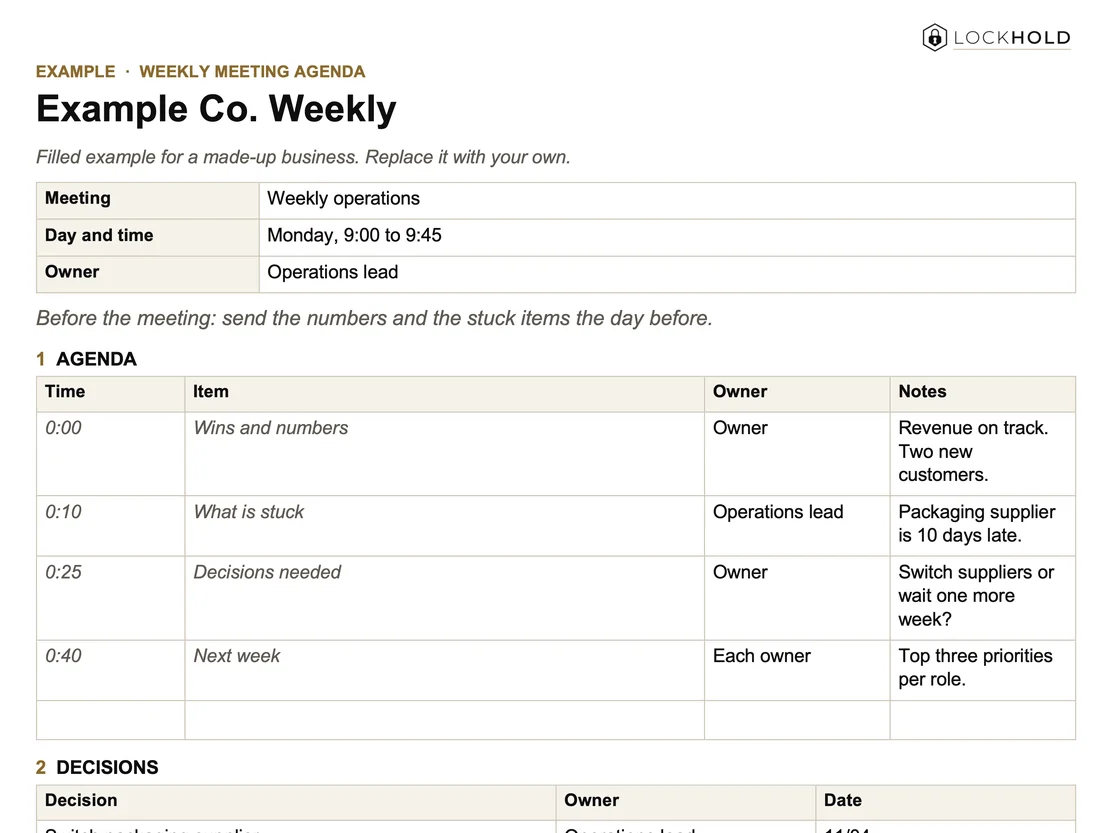
- A weekly meeting agenda: numbers, what’s stuck, decisions, next week. Every decision gets an owner and a date.
- An org chart by role, with what each role owns and who backs it up.
- A who-owns-what chart (RACI), plus a how-to page and a filled example.
Here's your weekly meeting kit.
We also emailed you a copy, and you’ll get our monthly operator note. Unsubscribe any time.
That didn't go through. Please try again, or email hello@lockhold.com.
Common mistakes
Two owners, too many people consulted, and a chart nobody looks at.
Two Accountables.
Shared ownership usually means no ownership. Pick one.
The owner is Accountable for everything.
Then the chart describes the problem instead of fixing it.
Everyone is Consulted.
Every decision waits for a meeting. Consult only the people whose input changes the outcome.
Names instead of roles.
It breaks the first time someone leaves.
Built once, never used.
If nobody looks at it when something goes wrong, it’s decoration.
Keeping it current
Use it in the weekly meeting, and update it when the work changes.
The RACI earns its keep in the weekly operating rhythm: when something is stuck, the first question is who’s Accountable, and the answer is already written down. When a process changes hands, update the chart the same day. Our guide on how to delegate covers the handoff itself.
the free weekly meeting kit includes an org chart by role and a ready-to-fill RACI, with a filled example.
Who Owns What: Org Chart and RACI
One owner for each process: the chart that stops work running through you. One page, ready to print or share with your team.
Your guide is ready.
We also emailed you a link to your library, so you can come back to it from any device.
That didn't go through. Please try again, or email hello@lockhold.com.
FAQ
What is a RACI chart?
A chart that lists the processes in a business and, for each one, who is Responsible for doing the work, who is Accountable for the outcome, who is Consulted before decisions, and who is Informed after.
What is the difference between an org chart and a RACI?
An org chart shows roles and reporting lines. A RACI shows who owns each process, including work that crosses several roles. The RACI is the one that tells you who to ask when something goes wrong.
Can more than one person be Accountable in a RACI?
No. Each process should have exactly one Accountable person. When two people share accountability, each assumes the other has it, and the work falls back to the owner.
Does a small business need a RACI?
If work keeps landing on the owner’s desk or falling between people, yes. A simple RACI for the ten or fifteen core processes takes an afternoon and makes ownership clear.
Want it built and running?
List the processes that still run through you. Name one Accountable role for each. That’s the start of the RACI. Then put it where the team can see it.
If you want the processes, owners and weekly rhythm built with you, that’s the work a fractional COO takes on, handed over running.
Related guides and work
Everything still runs through me
The signs, what should stay with the owner, and what to hand off first.
Read the guide GuideThe weekly operating rhythm that actually runs
The agenda, the numbers to review, how to run the meeting, and how to keep it going without you.
Read the guide ServiceFractional COO
The COO work, without the full-time hire: systems, reporting and handoffs built and handed over.
Read →