


Quick answer
If the business can run for 90 days without you, the systems are built. That means the core processes are written and owned, the weekly numbers are reviewed without you, exceptions have a path that doesn’t end with you, customers and vendors know who to call, and cash is visible every week. Build what stops when you’re gone first, then test it: a week away, then longer.
Why 90 days
Long enough that nothing can wait for you to come back. Short enough to plan for.
A week away tests whether the day-to-day keeps moving. Ninety days tests everything else: a month-end close, a quarter of numbers, a supplier problem, a customer complaint, a hire. If the business handles all of that without you, it doesn’t depend on you.
Owners work toward this for different reasons: selling the business, a sabbatical, a second venture, a health or family need, or simply wanting a season back. The work is the same either way.
What has to be true
Five things, before you step out.
The core processes are written and owned.
Each one on a page, with one role responsible for it.
The weekly numbers are reviewed without you.
Someone else runs the meeting and acts on what’s off track.
Exceptions have a path that doesn’t end with you.
Who decides what, and up to what amount or risk.
Customers and vendors know who to call.
Not your cell phone. A named person for each relationship.
The cash position is visible every week.
Someone owns it, and you can see it from anywhere.
What to build first
Start with the processes that stop when you’re gone.
List what stops.
Write down everything that would stall if you left for a week. That list is what still runs through you.
Write those processes.
At one page each: the steps, the tools, and what done looks like.
Name the owners.
One role per process, and a backup for the critical ones.
Put the work in the team’s tools.
Out of your inbox and your head, into shared places everyone can see.
Set the weekly rhythm.
A weekly operating rhythm: fixed meeting, fixed numbers, decisions with owners and dates.
Write the decision rules.
What the team can decide, what needs a call, and what waits for you.
Add cash to the weekly meeting with a 13-week cash flow forecast, so the team sees a cash gap coming weeks ahead, not the week it lands.
The step-out test
Test it in steps. Each one shows you what to fix before the next.
One week, reachable.
Step out of the day-to-day but answer questions. Write down every question you get. Each one is a missing process or a missing decision rule.
Two weeks, reachable for emergencies only.
Agree in advance what counts as an emergency. Review what happened when you’re back.
A month, with a weekly check-in.
Read the numbers and the decision log once a week. Step in only for decisions only the owner should make.
Ninety days.
The real test. If the first three steps went well, this is mostly about trust.
After each step, fix what came up before you take the next. The questions you got are the most useful thing the test produces.
The weekly meeting kit
The weekly rhythm that keeps a business running without you in every decision. Works in Word and Google Docs.
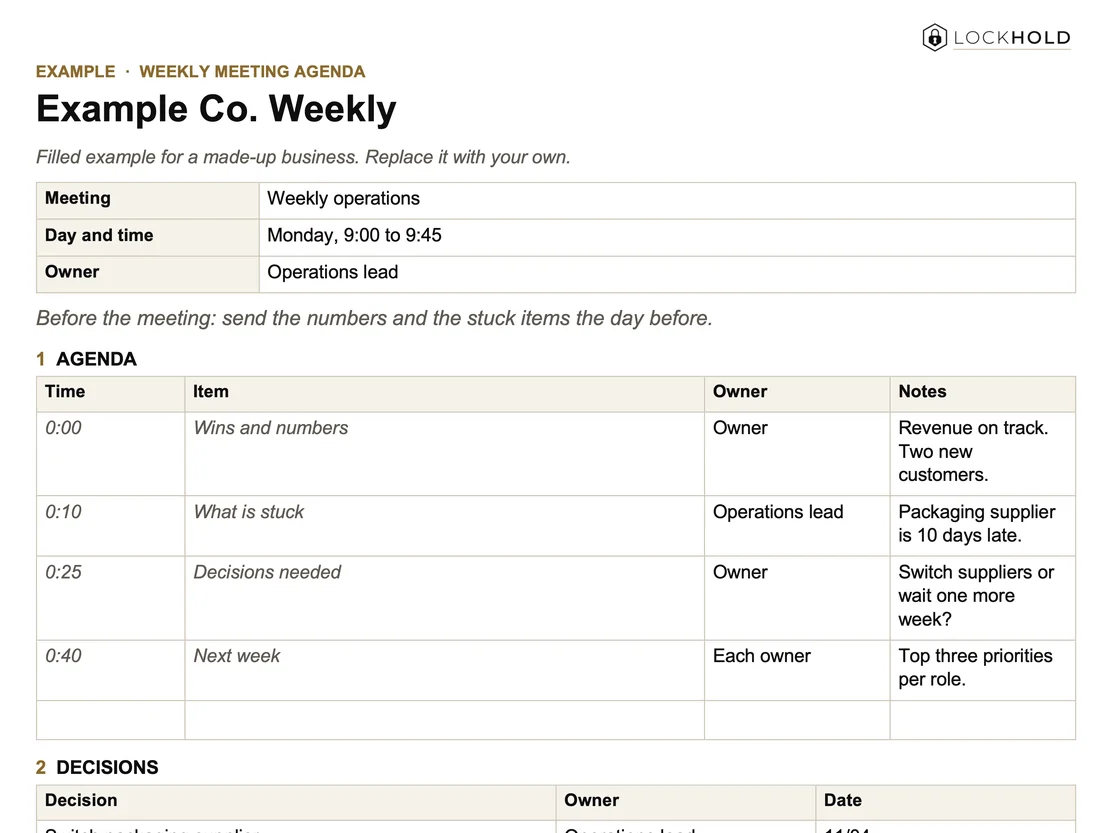
- A weekly meeting agenda: numbers, what’s stuck, decisions, next week. Every decision gets an owner and a date.
- An org chart by role, with what each role owns and who backs it up.
- A who-owns-what chart (RACI), plus a how-to page and a filled example.
Here's your weekly meeting kit.
We also emailed you a copy, and you’ll get our monthly operator note. Unsubscribe any time.
That didn't go through. Please try again, or email hello@lockhold.com.
How you know it’s ready
The work moves, the numbers are reviewed, stuck items have owners, and you’re not the system.
If the business can’t run for a week without you, it can’t run for 90 days. Go back to the list of what stopped and build those first.
What you keep while you’re away
Direction, the biggest decisions, and a weekly look at the numbers.
Stepping out doesn’t mean disappearing. Most owners keep a short weekly check-in: read the numbers and the decision log, and answer the decisions only the owner should make, like pricing changes, key hires and serious risks. Everything else belongs to the people who own it.
How to Run Without You for 90 Days
For a sale, a sabbatical, or a season you want back. One page, ready to print or share with your team.
Your guide is ready.
We also emailed you a link to your library, so you can come back to it from any device.
That didn't go through. Please try again, or email hello@lockhold.com.
FAQ
How do I make my business run without me?
Write down the processes that stop when you’re away, name an owner for each, put the work in shared tools, set a weekly meeting with fixed numbers, and write decision rules. Then test it by stepping out for a week.
How long does it take to prepare a business to run without the owner?
It depends on how much still runs through you. Many owners can step out for a week within a couple of months of focused work. Ninety days usually takes longer, built and tested in steps.
What should I check on while I’m away from my business?
The weekly numbers, the cash position and the decision log. Step in only for decisions that should stay with the owner, like pricing, key hires and serious risks.
Why do buyers care if the business runs without the owner?
A buyer is paying for future profit. If the business depends on the owner, that profit may leave with them. A business that has already run without its owner carries less risk.
Want it built and running?
Write down the processes that would stop if you left for a week. Build those first. Then test it: one week, reachable, and write down every question you get.
If you want it built with you, that’s the work a fractional COO takes on: processes, owners and the weekly rhythm, handed over running. If a sale is the reason, see exit planning.
Related guides and work
Everything still runs through me
The signs, what should stay with the owner, and what to hand off first.
Read the guide GuideThe weekly operating rhythm that actually runs
The agenda, the numbers to review, how to run the meeting, and how to keep it going without you.
Read the guide ServiceFractional COO
The COO work, without the full-time hire: systems, reporting and handoffs built and handed over.
Read →